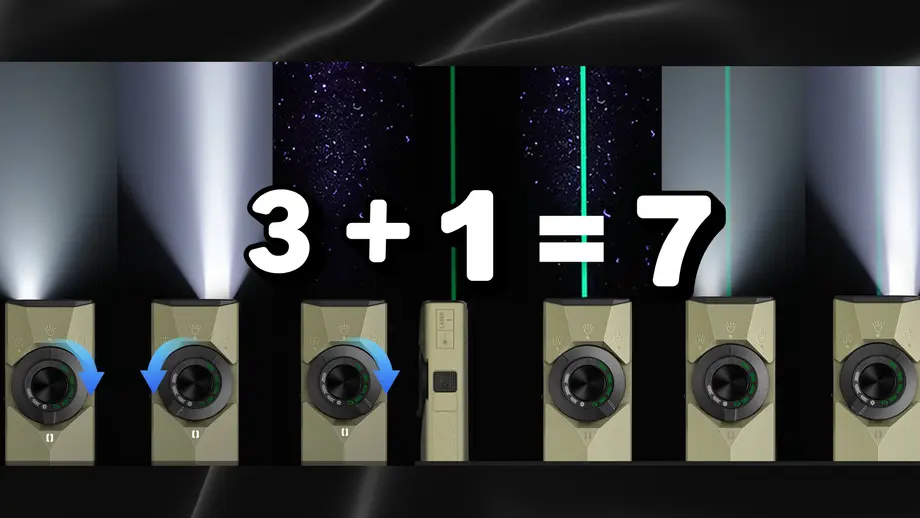
If you’ve seen Olight talking about “3+1=7” and wondered whether we’re breaking math rules… don’t worry — this equation isn’t about numbers in a textbook.
It’s about unlocking all seven lighting modes inside the powerful and compact ArkPro.
So what does it really mean?
Simple:
3 light sources + 1 green laser = 7 total lighting modes
Here’s how “3+1” becomes seven:
| Mode | What It Uses | Best For |
|---|---|---|
| 1️⃣ Pure Flood | Floodlight only | Everyday close-range lighting |
| 2️⃣ Spotlight | Spotlight only | Distance spotting and search |
| 3️⃣ Laser | Laser only | Targeting and pointing |
| 4️⃣ UV | UV only | Inspection and detection |
| 5️⃣ Laser + Flood | Combo | Precision with wide visibility |
| 6️⃣ Laser + Spot | Combo | Long-range adjustment + laser target |
| 7️⃣ Laser + UV | Combo | Inspection while pointing the target |
You decide what the moment calls for — the ArkPro adapts instantly.
Let’s break down the magic. Seven! That’s like having a whole lighting studio clipped to your pocket.
So let’s break down each mode and show you exactly how the ArkPro can level up your next adventure — whether you’re chasing excitement or just trying not to trip over a log in the dark.
- Pure Flood Mode
- Spotlight Mode
- UV Light Mode
- Green Laser Mode
- Floodlight + Laser Mode
- Spotlight + Laser Mode
- UV Light + Laser Mode
Pure Flood Mode
The pure floodlight mode casts a wide, even beam of light, designed to illuminate your immediate surroundings. Think of it as turning on a room light, but for the outdoors. There are no harsh hotspots or dark patches, just a smooth field of vision.

Practical Uses:
- Setting up Camp: Light up your entire campsite to easily pitch your tent, prepare your sleeping area, and organise your gear without fumbling in the dark.
- Campsite Cooking: Provides broad, even light over your cooking station, making food prep and cooking safer and easier.
- Inside a Tent: Offers comfortable, non-blinding light for reading, playing cards, or finding items inside your tent.
- Group Activities: Perfect for illuminating a small area for a group of people, whether you're gathered around a map or a campfire.
Spotlight Mode
When you need to see what's further down the track or across a clearing, the spotlight mode is your go-to. It projects a focused, intense beam of light over a long distance, cutting through the darkness to pinpoint specific objects far away.

Practical Uses:
- Night Hiking and Navigation: Identify trail markers, potential hazards, or landmarks from a distance to stay on course.
- Wildlife Spotting: Observe nocturnal animals from a safe distance without disturbing them with a wide, intrusive light.
- Signalling: The powerful, focused beam can be used to signal for attention or help over long distances.
- Checking Your Surroundings: Quickly scan the tree line or the other side of a paddock to assess your environment.
UV Light Mode
The UV (ultraviolet) light mode is a specialized tool that reveals things invisible to the naked eye. It causes certain materials and substances to fluoresce, or glow, making them easy to spot.

Practical Uses:
- Checking for Scorpions: In certain parts of Australia, scorpions are a real concern. They glow brightly under UV light, making it easy to spot them around your campsite before they become a problem.
- Verifying Currency and IDs: The UV light can reveal security features on Australian banknotes and official identification cards.
- Fishing Lure Activation: Many modern fishing lures are coated with UV-reactive paint that "charges" under UV light, making them more attractive to fish in deep or murky water.
- Leak Detection: Useful for checking for fluid leaks in vehicle engines or air conditioning systems if a UV dye is present.
Green Laser Mode
The green laser provides a highly visible, precise dot that is easily seen during both day and night. It's not for illumination, but for pointing and indicating.

Practical Uses:
- Presentations and Instruction: In a group setting, use the laser to point out distant landmarks, constellations in the night sky, or specific points on a map without having to describe them.
- Construction and Alignment: Useful for indicating points and ensuring alignment over short to medium distances in DIY projects.
- Emergency Signalling: A moving laser dot is highly noticeable and can be used to draw attention in an emergency situation. Note: Never point a laser at aircraft, vehicles, or people.
Floodlight + Laser Mode
This combination mode gives you the best of both worlds for close-quarters tasks that require indication. You get the wide, even illumination of the floodlight to see your work area, plus the precise dot of the green laser to point things out.

Practical Uses:
- Collaborative Tasks: Perfect when working with a partner at night. One person can illuminate the general area while using the laser to direct the other person's attention to a specific bolt, knot, or gear part.
- Nighttime Instruction: Ideal for teaching someone a task in the dark, such as how to tie a specific knot or operate a piece of equipment, by lighting the area and pointing to the exact spot.
Spotlight + Laser Mode
Combining the long-distance spotlight with the green laser allows you to both illuminate and pinpoint objects far away. The spotlight punches through the darkness, and the laser provides an exact reference point within the beam.

Practical Uses:
- Advanced Navigation: Illuminate a distant ridgeline with the spotlight and use the laser to indicate the specific path or gap you're aiming for to your group.
- Search and Rescue Scenarios: A searcher can light up a large area with the spotlight and use the laser to precisely indicate a point of interest to other team members.
- Pointing out Wildlife: Shine the spotlight in the general direction of an animal and then use the laser to pinpoint its exact location for others to see through binoculars.
UV Light + Laser Mode
This is a highly specialized combination. It allows you to use the unique detection properties of the UV light while simultaneously having a precise pointer for indication.

Practical Uses:
- Scientific Fieldwork: A biologist could use the UV light to find fluorescent minerals or insects and then use the laser to point out the specific sample to a colleague for collection.
- Detailed Inspection: When inspecting for UV-reactive substances (like specific fluids or markings), you can use the laser to indicate the exact location of a faint fluorescent trace to others.