Precision and speed are the fundamental pillars of modern tactical shooting. Whether you are navigating a competitive course, hunting in the Australian bush, or managing professional duty requirements, your choice of optics directly defines your performance. The reflex sight has emerged as the premier solution for shooters seeking the ultimate balance of rapid target acquisition and unwavering reliability.
By 2026, technological breakthroughs in battery efficiency, reticle clarity, and structural durability have pushed these optics into a new era of performance. This comprehensive guide explores the mechanics, tactical benefits, and essential selection criteria for finding the ideal reflex sight to optimize your shooting platform.

What Is a Reflex Sight?
Definition and Basic Working Principle
A reflex sight (short for reflector sight) is a non-magnifying optical device that enables the user to look through a partially reflecting glass element and see an illuminated projection of an aiming point—or reticle—superimposed on the field of view. Unlike traditional telescopic scopes, it does not require a specific eye relief, allowing the shooter's eye to be positioned at varying distances from the optic without losing the sight picture.
How a Reflex Sight Differs from Traditional Iron Sights
Traditional iron sights require the shooter to align three separate planes: the rear sight, the front sight, and the target. This process is time-consuming and forces the eye to focus strictly on the front sight, often leaving the target blurred. A reflex sight simplifies this into a single focal plane. By focusing on the target, the reticle appears naturally where the shot will land, significantly reducing cognitive load and improving response times during high-stress situations.
Reflex Sight vs. Red Dot Sight – Are They the Same?
While often used interchangeably, "red dot sight" is a broad umbrella category that includes reflex sights, holographic sights, and prism sights. A reflex sight specifically refers to the optical technology where an LED reflects off a lens toward the shooter’s eye. Essentially, all reflex sights are red dots (or green dots), but not all red dots utilize reflex technology.

How Does a Reflex Sight Work?
LED Projection System Explained
The core of a reflex sight is a high-efficiency light-emitting diode (LED). This LED is positioned behind a precision-curved lens, aiming a beam of light—typically red or green—at the inner surface of the objective lens. Because the light source is a calibrated point of light, it appears as a sharp, clear dot or reticle to the shooter.
Lens Coating and Reflective Technology
The lens of a professional reflex sight is treated with a specialized multi-layered dichroic coating. This coating is engineered to reflect only the specific wavelength of the LED light (e.g., 650nm for red) back to the shooter's eye, while allowing all other light from the environment to pass through clearly. This ensures the target remains vibrant and visible while the reticle stays bright and distinct.
Parallax-Free Design and Accuracy
Modern high-performance units, such as the Osight, are engineered to be virtually parallax-free. This means that as long as the dot is visible on the target, your shot will be accurate, even if your head is not perfectly centered behind the optic. This is a critical tactical advantage when shooting from unconventional positions or during rapid movement.
.JPG&c=ae5f00bf06c40a51ee93e5a177dc1a04&x=1024&y=1024&a=1&t=KmzlR9hFp5MnSu8)
Key Features to Look for in a Reflex Sight
Reticle Types (Dot, Circle Dot, Multi-Reticle)
Choosing the right reticle depends on your specific shooting application:
- Single Dot: The gold standard for precision at distance.
- Circle Dot: Optimized for lightning-fast acquisition in close-quarters environments.
- Multi-Reticle System (MRS): Advanced models like the Osight XR offer a versatile 2/6 MOA dot combined with a 32 MOA circle, allowing users to toggle based on mission requirements.
Brightness Settings and Auto-Adjustment
Tactical lighting conditions shift rapidly. A professional-grade sight should offer multiple daylight levels and Night Vision (NV) compatible modes. Light sensor technology, featured in the Osight X, automatically adjusts reticle intensity based on ambient light to prevent "washout" in bright sun or "blooming" in low-light environments.
Battery Life and Power Efficiency
In 2026, industry standards demand extreme longevity. Olight’s Osight series utilizes rechargeable lithium-polymer batteries and innovative charging covers to extend runtime. For instance, the Osight can provide over 70,000 hours of potential operation.
Motion Activation / Shake Awake Technology
To maximize power conservation, high-end sights feature integrated motion sensors. If the firearm remains stationary, the optic enters sleep mode. The moment movement is detected, the "Shake Awake" function instantly restores the reticle to its previous setting.
Durability – Waterproof, Shockproof, Fogproof
Reliable gear must survive harsh elements. Prioritize IPX6 or IPX7 waterproof ratings. Housing materials like 7075-T6 aluminum or OAL™ (O-Aluminum) provide the structural integrity required to withstand the heavy recoil of shotguns and high-caliber rifles.
Mounting Compatibility and Footprint Standards
The "footprint" refers to the mounting hole pattern of the sight's base. Common industry standards include:
- Trijicon RMR: The standard for full-size pistols and rifles.
- RMSc: Optimized for subcompact and micro-compact pistols, as used by the Osight SE.
.JPG&c=cd2f2842b94094086221a3aaceb1f848&x=1024&y=1024&a=1&t=KmzlR9hFp5MnSu8)
Benefits of Using a Reflex Sight
Faster Target Acquisition
By eliminating the need to align front and rear sights, you can bring the firearm to eye level and engage targets immediately. Training data consistently proves that reflex sights are significantly faster for both novice and expert shooters alike.
Improved Accuracy in Close to Mid-Range Shooting
The clarity of a 2 MOA or 3 MOA dot provides a precise aiming point that does not obscure the target. This is particularly advantageous when tracking moving targets or engaging at varying distances up to 100 meters.
Both-Eyes-Open Shooting Advantage
Reflex sights are designed for "binocular" shooting. Keeping both eyes open allows you to maintain full peripheral vision and superior situational awareness—crucial in tactical, hunting, or self-defense scenarios.
Lightweight and Compact Design
Modern optics add minimal bulk. The Osight S weighs a mere 27.5g, ensuring it does not compromise the balance or handling characteristics of your firearm.

Open Reflex Sight vs. Enclosed Reflex Sight
Structural Differences
- Open Reflex: Features a single lens element with an exposed LED emitter.
- Enclosed Reflex: The LED and optics are sealed within a housing with protective glass on both ends, creating a protected environment.
Pros and Cons of Open Reflex Sights
- Pros: Maximal field of view, lightest possible weight, ultra-low profile.
- Cons: The open emitter can potentially be blocked by debris like mud, snow, or heavy rain.
Pros and Cons of Enclosed Reflex Sights
- Pros: Emitter is fully shielded from the environment; easier to wipe clean in the field.
- Cons: Slightly more mass, can create a minor "tunnel" visual effect compared to open designs.
Which One Should You Choose?
For concealed carry where the firearm is protected by a holster and clothing, an open sight like the Osight K is ideal. For professional duty or harsh outdoor environments, an enclosed model like the Osight XR is the superior choice for rugged reliability.
.JPG&c=cb283630a931ab6deb92bcfa0b6c0b70&x=1024&y=1024&a=1&t=KmzlR9hFp5MnSu8)
Best Applications for Reflex Sights
Handguns
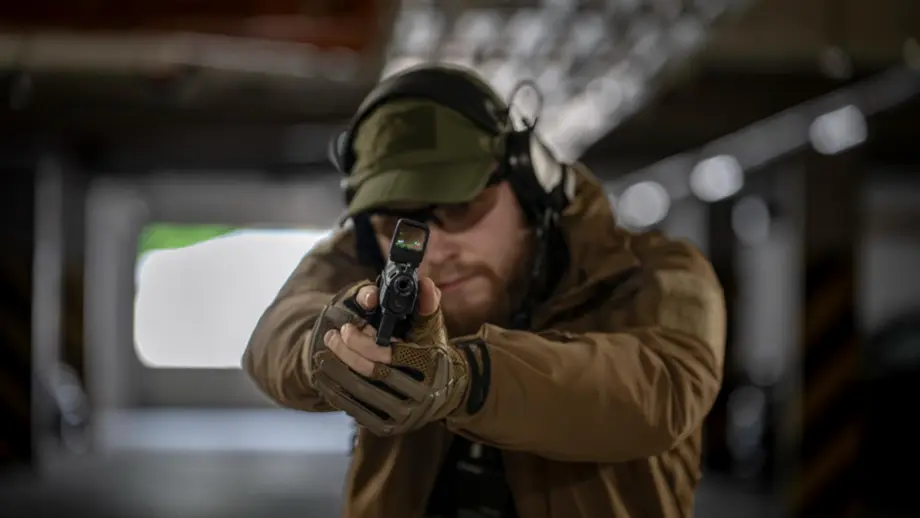
Modern pistols are increasingly "optics-ready." Reflex sights transform handguns into highly capable tools for competition and protection. The Osight S is specifically optimized for these compact platforms.
Rifles and Carbines
On AR-style platforms, reflex sights provide unmatched speed for close-quarters battle (CQB). They are frequently used as primary optics or as backup sights mounted at a 45-degree offset alongside magnified scopes.
Shotguns
Shotgun recoil is punishing. Heavy-duty sights like the Osight C are built to withstand this shock while making target lead and bird tracking significantly easier.

How to Choose the Best Reflex Sight
Consider Your Firearm Platform
A micro-compact pistol requires a small footprint like the Osight SE. Conversely, full-sized duty rifles benefit from larger, more robust enclosed optics that offer a broader field of view.
Determine Ideal MOA Size
- 2-3 MOA: Precise and versatile for most applications.
- 6 MOA: Large and easy to track; preferred for close-range speed.
- Circle-Dot: Best for high-speed engagement where the circle provides an immediate visual reference.

Reflex Sight Maintenance and Care Tips
Cleaning the Lens Properly
Avoid using rough clothing. Utilize a dedicated lens pen or a clean microfiber cloth with specialized lens cleaner. Always blow off loose dust before wiping to avoid scratching the delicate dichroic coatings.
Regular Zero Check and Recalibration
Recoil and extreme temperature shifts can occasionally impact your zero. Verify your point of aim against your point of impact every few months. Most Olight models feature 1 MOA per click adjustments for simple, precise recalibration.

Frequently Asked Questions About Reflex Sights
Are reflex sights accurate at long distances?
While optimized for speed within 0-100m, they remain accurate as long as the dot does not fully obscure the target. For precision shooting beyond 200m, a magnified optic is generally more effective.
| Model | Reticle Type | Window Size | Battery Life | Primary Use |
|---|---|---|---|---|
| Osight 3 MOA | 3 MOA Dot | 24 x 21.5 mm | 70,000+ Hrs | Competition / Hunting |
| Osight X | 3 MOA & 32 MOA | 24 x 21.5 mm | 77,000+ Hrs | Duty / Training |
| Osight S | 2 MOA & 32 MOA | 21 x 14 mm | Rechargeable | Concealed Carry |
| Osight XR | 2/6 MOA & 32 MOA | 23 x 18 mm | Enclosed | Tactical / Professional |
Investing in a high-quality reflex sight is one of the most effective ways to upgrade your shooting performance. By prioritizing features like motion activation, multi-reticle versatility, and robust housing, you ensure your equipment remains a reliable asset in any tactical environment.