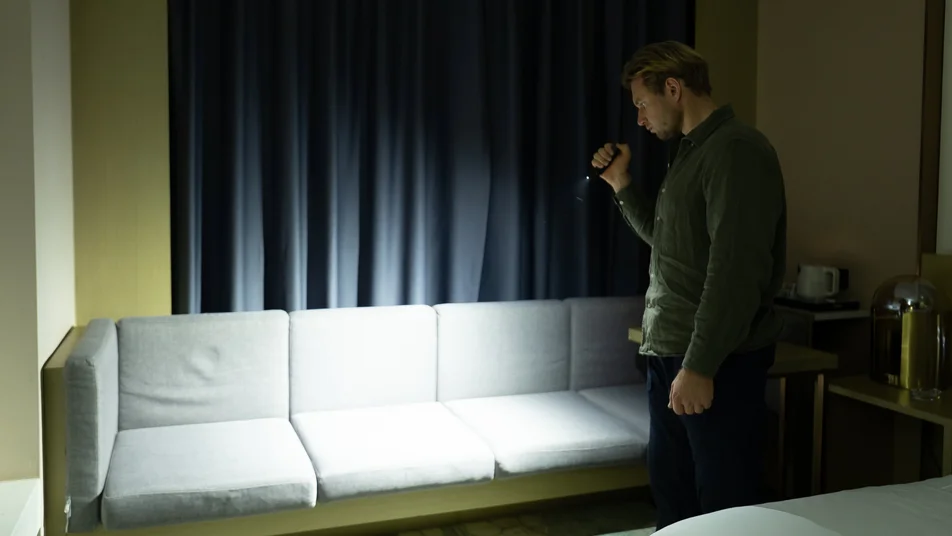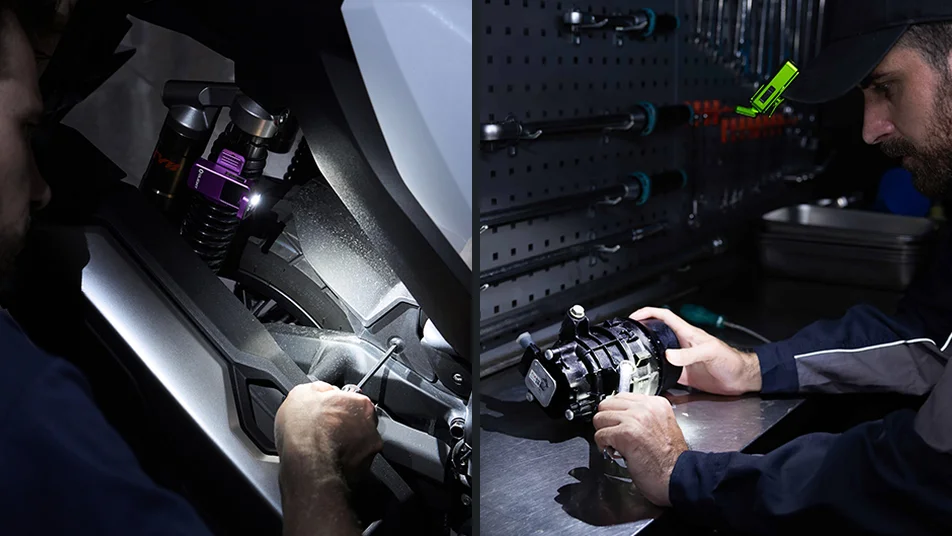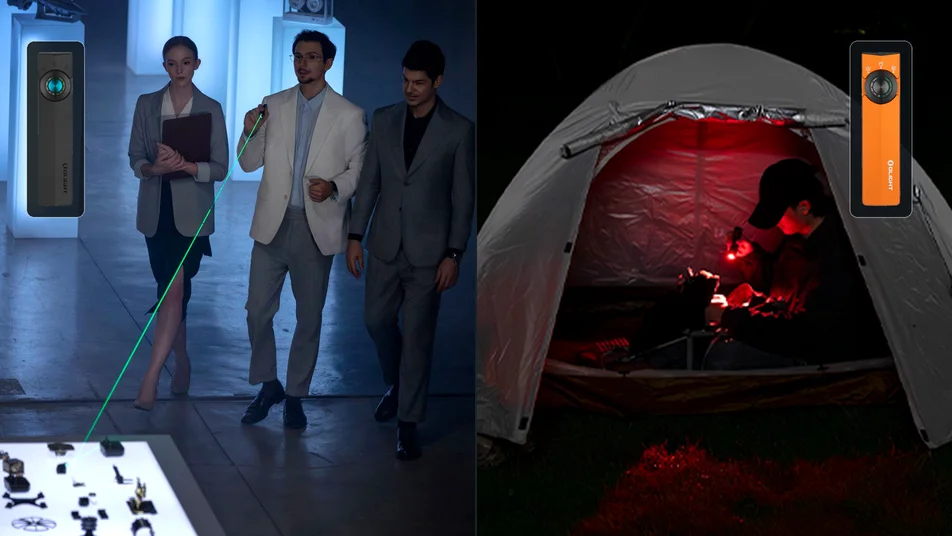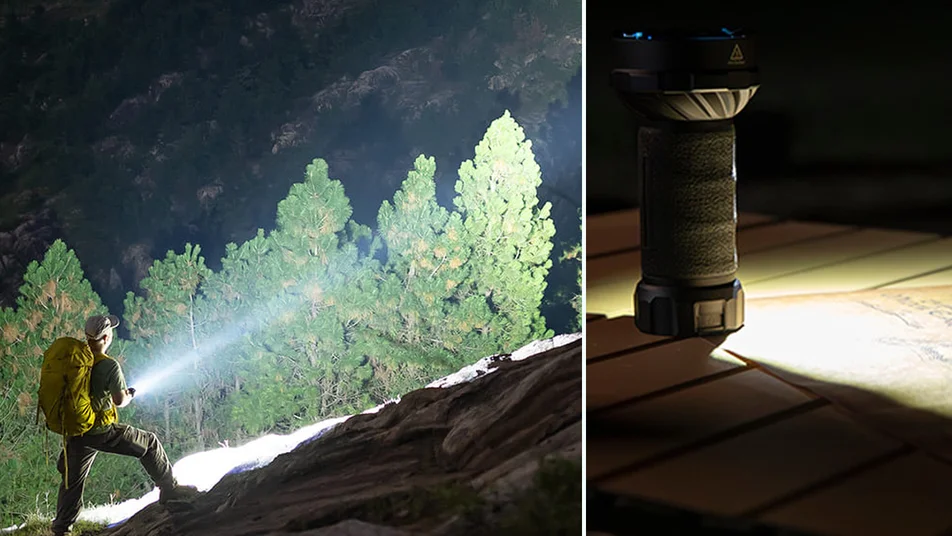
Quick answer
Choose the Olight Marauder 3 for repeated wide-area lighting from a campsite base, shed or vehicle. The Marauder Mini 2 weighs 375 g less and suits jobs that involve more walking and shorter checks. Both have flood and spot modes. Compare how long each holds its working brightness before deciding which to carry.
| Buying check | Marauder 3 | Marauder Mini 2 |
|---|---|---|
| Weight with battery | 840 g | 465 g |
| Length × head diameter | 152 × 75 mm | 133 × 66 mm |
| Maximum flood output | 25,000 lm | 10,000 lm |
| Maximum distance, spot only | 1,000 m | 750 m |
| Flood mode starting at 2,500 lm | 500 min at 2,500 lm, then 200 min at 375 lm | 30 min at 2,500 lm, then 60 min at 1,200 lm and 80 min at 600 lm |
| Battery and charging | Built-in 31,900 mAh battery. USB-C input and output. | Removable 7,500 mAh battery. USB-C or optional MCC3 magnetic charging. |
When does the Marauder 3 earn its place in the car?
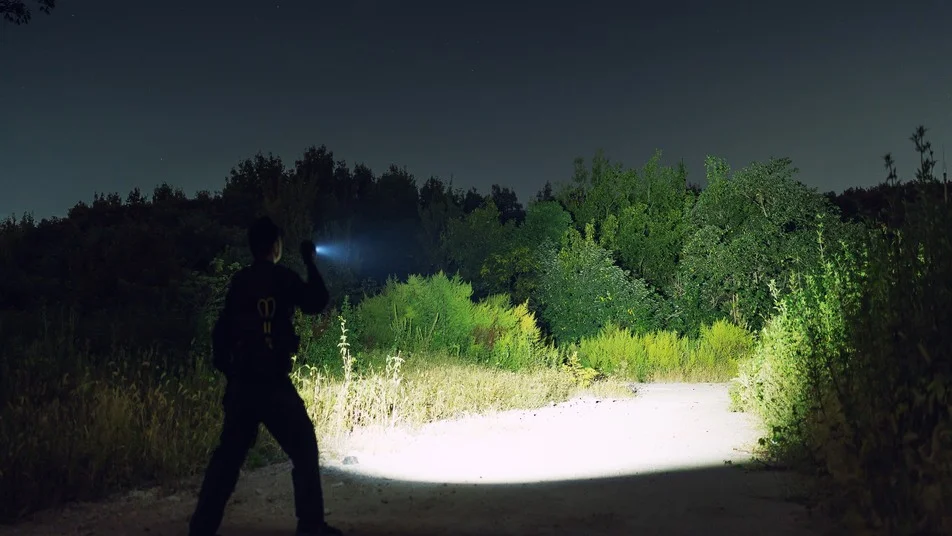
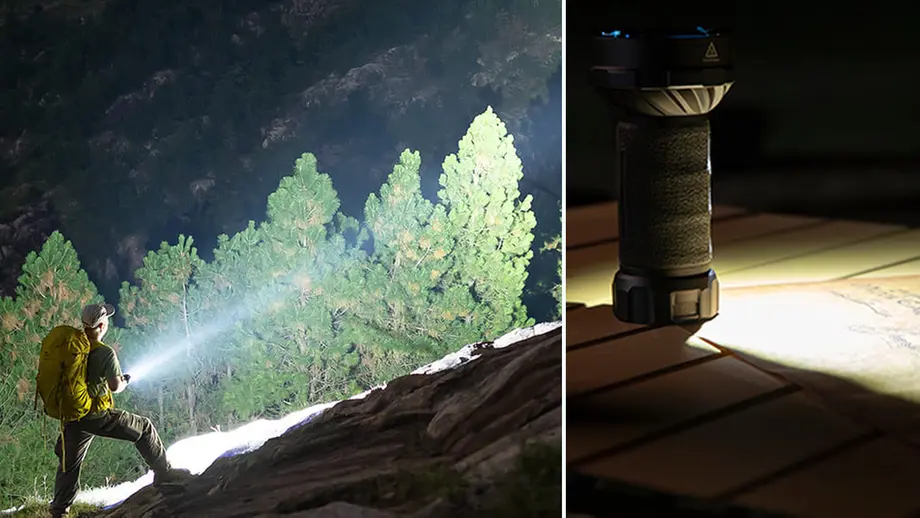
The Marauder 3 earns its weight when a large area needs light for more than a brief look. At a vehicle-based camp, use the flood to show the edge of the gravel, steps and gear that would disappear outside a narrow beam. When you stop to locate a gate or a sign farther away, switch to spot. Combined mode is handy when the foreground still matters and you also need the centre of the beam to reach farther.

Marauder 3
Wide-area lighting from a fixed base
Check the whole area from one position
Olight rates the flood at up to 25,000 lm and the spot at up to 1,000 m. The larger battery gives you more time on brighter working levels and can supply a phone through USB-C.
View Marauder 3The body is 152 mm long, but the 75 mm head matters more when you are choosing a storage spot. Check the diameter of the pouch or console opening and the space around the controls. The display can show an estimated operating time for the selected setting. Look again after changing modes, especially if you switch from a short spot check to a wide beam for the rest of the job.
Where is the Marauder Mini 2 the better fit?
If you will carry the torch between the car, camp kitchen and amenities block, the Marauder Mini 2 is easier to justify. The 465 g body takes 375 g off your load before the case and accessories go in. Plan for a daypack or a larger kit pocket. For a commute that simply ends at an unlit front door, a small pocket torch is easier to carry and already covers the job.

Marauder Mini 2
Lighter searchlight for moving between jobs
Move easily between near and far checks
Use the side light for nearby gear, then switch to the front spotlight when you need extra reach. Olight rates the flood at up to 10,000 lm and the spot at up to 750 m.
View Marauder Mini 2The Mini 2 uses a selector for front, red and side light and a separate switch for selecting the front beam pattern. Try switching between a low flood and the spot before you head out. It is also worth getting used to the lockout, so you can turn the light on promptly when you pull it out of a packed bag.
How much light remains after the first few minutes?
Compare the same beam at the same starting output. In Olight’s tables, the Marauder 3 starts at 5,000 lm in flood level L4 and reaches 3,500 lm after four minutes. Olight lists another 330 minutes at that lower output, followed by a 2,500 lm stage. The Mini 2 also starts at 5,000 lm for four minutes, then runs for 90 minutes at 2,500 lm and 80 minutes at 550 lm.
That makes 5,000 lm a sensible starting point for a short look across a yard. For an extended job, ask whether 3,500 or 2,500 lm will still give you the coverage you need. The Marauder 3 manual and Marauder Mini 2 manual give the full sequences. Battery charge, temperature and cooling can change when the torch steps down. PLATO’s updated flashlight standard also treats brief Turbo or Boost output as a distinct rating from sustained brightness. (Source: PLATO, revised FL 1 flashlight standard)

How would you use each torch at a summer campsite?
- Unpack after dark. Use low flood to find the edge of the site, then keep a low side light or a lantern by the tailgate. If you are carrying boxes or pitching a tent, switch to a head torch so you have both hands free.
- Check past camp. Keep the spot for a brief check along the access track. If you need the Marauder 3 to light a whole work area, pick a flood level you could use after the first step-down and point it clear of neighbouring tents.
- Get back after dark. Take the lighter torch if you will carry it throughout the evening. Leave a second, charged light where campmates can find it. Queensland’s camping checklist includes a torch for walking at night. (Source: Queensland Government camping equipment checklist)
What will the beam-distance rating tell you?
The 1,000 m and 750 m ratings compare the two spot beams. In an FL 1 comparison, the distance marks a defined low illuminance at the centre of the beam. A bright gate reflector and an unpainted step at the same distance can be very different to pick out. Dust, rain and light reflected from the foreground can all reduce useful visibility. Check the target you need to recognise and leave yourself enough light for the way back. (Source: ANSI/PLATO FL 1 flashlight performance standard)
Read the combination figures separately. Olight reports up to 1,050 m in combined mode on the Marauder 3 and up to 700 m on the Mini 2. The combined mode lights the foreground as well, which is handy for a stationary check when both areas matter. For walking or working near shiny tools, turn the output down and aim the flood where you need it.
What should you pack for charging and close work?
The Marauder 3 has a built-in battery and can charge another device over USB-C. Set aside enough battery for lighting before using it as a power bank. Olight specifies an operating and charging range of 0–40 °C and recommends a suitable adapter rated at 30 W or more for the quoted charge time of approximately five hours. On a hot trip, keep the torch out of a parked vehicle that is heating up and let it cool before recharging.
The Mini 2 can recharge with its USB-C lanyard cable or an optional MCC3 magnetic cable. A charged, compatible spare battery is useful where there is no outlet. For a job where the light cannot go out, a second torch avoids having to change batteries in the dark. For either rechargeable torch, check which cable and adapter are in the exact kit before you pack.
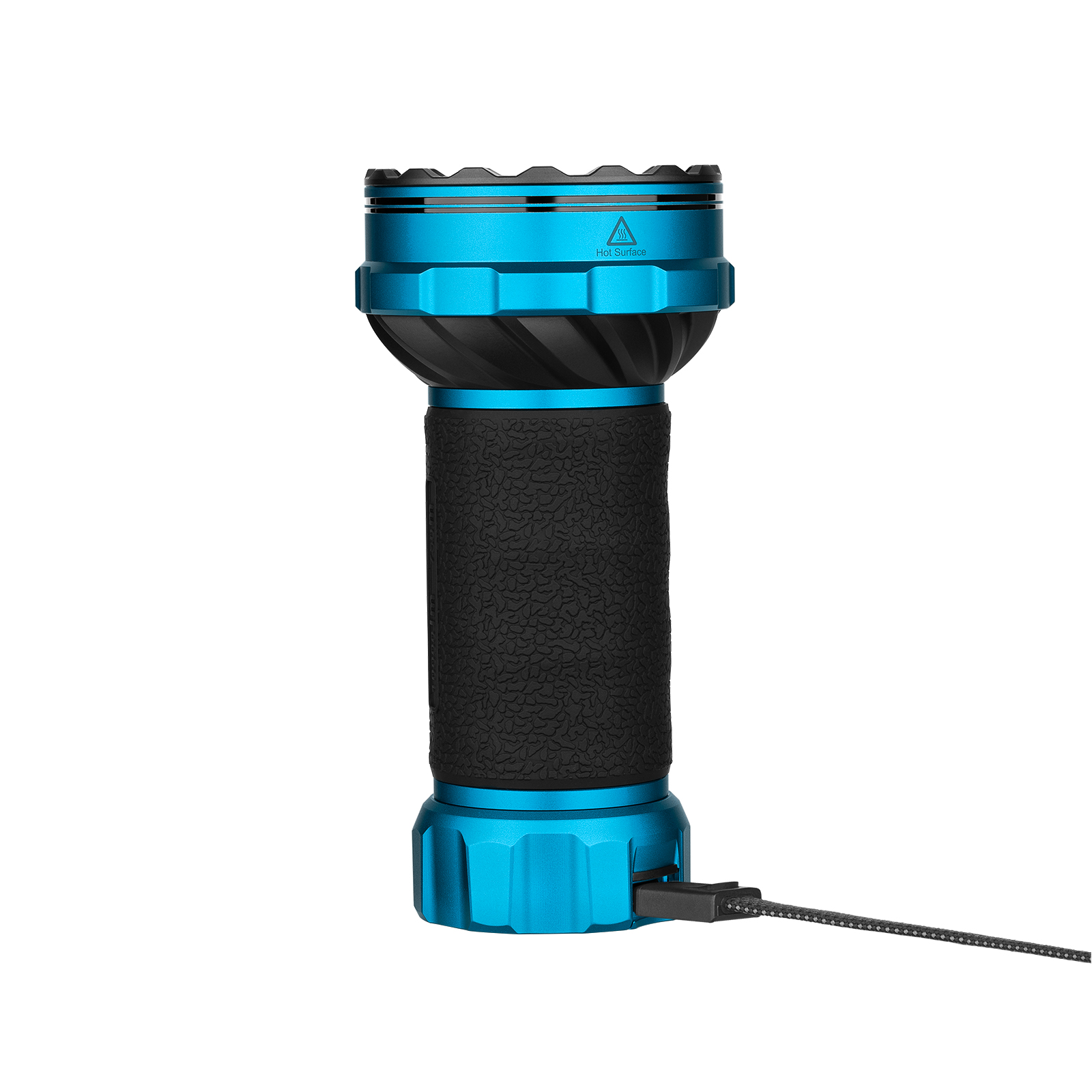
Olight lists the Marauder 3 in Black, Orange and Midnight Blue. Check the Australian product selector for the colour you want. If you encounter a bundle labelled ArkPro or Oclip, check exactly which compact light it includes. A small hand torch suits jobs like looking into a drawer, while a stable clip light can free both hands. An existing close-work light fills the same role.
Which choice fits most of your jobs?
- Take the Marauder 3 if most jobs involve lighting a wide area for a while and the torch can stay at a base.
- Take the Mini 2 if you will carry the torch for longer than you will use its highest output and want the option of a replaceable battery.
- Keep your current torch if it already shows the footing or tools in front of you. Use a head torch if both hands are busy.
Frequently asked questions
Which searchlight features matter for small jobs after dark?
Start with an accessible low flood setting and a grip you can use comfortably. A side light can help at the tailgate or bench. If you need to work with both hands or walk with trekking poles, a head torch may be a better everyday choice.
When is the Marauder 3 worth the extra 375 g?
The Marauder 3 makes sense when you repeatedly light a wide area and the torch can stay within easy reach of the vehicle, bench or campsite. Its published floodlight runtimes at higher working levels matter most when your work lasts beyond the first few minutes.
Can I run the Marauder 3 at full output while charging?
Olight limits lighting to level L4 while the Marauder 3 is charging or supplying power to another device. For a job that needs more light, start with a charged torch and keep a separate power bank for your phone.