TL;DR: The best head torch for mechanics prioritises a wide, homogeneous flood beam over long throw, low-lumen modes (30 to 120 lumens) to prevent blinding reflection, high ingress protection (IP68), oil-resistant straps, and hands-free versatility. Right-angle lights with magnetic tailcaps offer seamless transitions between headband mounting and magnetic bay attachment.
| Key Workshop Feature | Recommended Specification | Why It Matters Under the Bonnet |
|---|---|---|
| Beam Profile | Wide flood / TIR lens | Eliminates tight hotspots that wash out wiring harnesses at arm's length. |
| Working Output | 30–150 lm (close-up) / 600+ lm (inspection) | Prevents eye strain and glare off polished tools, chrome, and safety eyewear. |
| Battery & Runtime | High-capacity Li-ion (e.g., 21700 5000mAh) | Sustains continuous low/medium output across an entire 8- to 10-hour shift without dimming. |
| Durability | IP68 waterproof + 1.5m drop resistance | Withstands exposure to engine oil, brake dust, solvent mist, and concrete drops. |
Working inside an automotive bay presents lighting challenges that general outdoor torches cannot resolve. Between deep engine crevices, narrow transmission tunnels, and tight dashboard cavities, Australian automotive technicians require hands-free lighting that prevents harsh reflection while accurately rendering wire colours and fluid hues. This guide breaks down the technical beam parameters, mounting ergonomics, runtime dynamics, and maintenance practices required to choose the ultimate headlamp for mechanics.
Quick answer: a wide flood with a dimmable low for close work, good colour rendering for fluids and wires, and a strap that survives grease
The ideal head torch for mechanics does not rely on raw peak throw. Instead, it balances a broad, smooth beam profile with predictable output modulation. Confined vehicle spaces place work surfaces between 15 cm and 80 cm from your eyes. At this range, a concentrated hotspot causes severe pupil constriction, reducing peripheral visibility and causing rapid eye fatigue. Quality workshop lighting should provide reliable low-output levels (30 to 120 lumens) that preserve visual acuity, paired with quick access to higher bursts (600+ lumens) for spotting loose bolts in deep engine bays.
Workplace safety standards for trades establish that contrast fidelity and even illumination directly affect mechanical inspection accuracy (Source: Safe Work Australia Workplace Environment Code of Practice). Beyond optical quality, the chassis must incorporate robust solvent-resistant seals, an impact-resistant aluminium housing, and washable, silicone-backed or durable elastic strapping that resists motor oils and degreasers.
Under-dash, wheel arch and engine bay: the three reach distances that decide beam shape
Automotive maintenance typically operates across three distinct focal zones, each demanding specific beam characteristics:
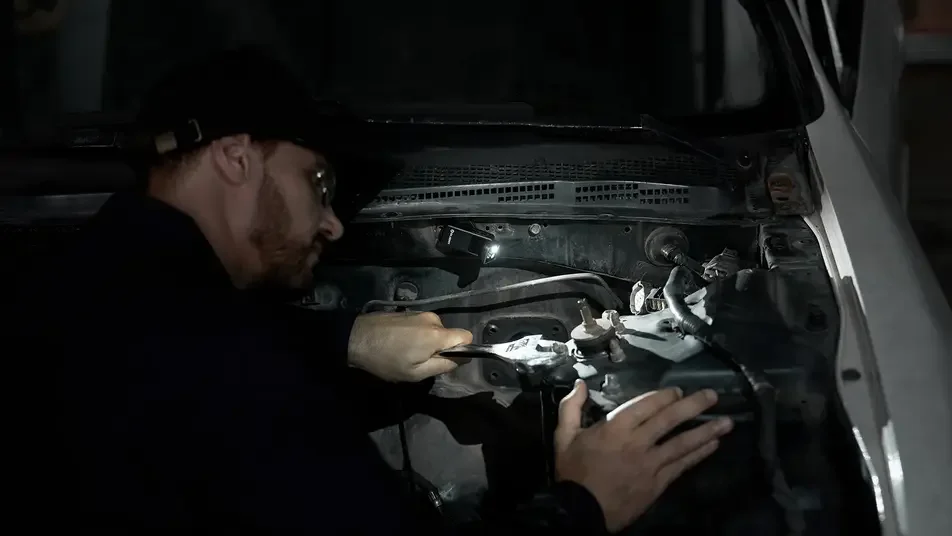
- Under-dash and footwell (10–30 cm): Ultra-short focal distance with multi-angle obstructions. Requires a soft, 120-degree flood beam without an intense centre spot to inspect fuse boxes, ECU looms, and pedal assemblies without blinding bounce-back.
- Wheel arch and suspension (30–60 cm): Mid-range workspace involving deep recesses behind brake discs, callipers, and strut towers. Demands balanced spill to illuminate control arm bushings and brake lines simultaneously.
- Engine bay and undercarriage (60–150 cm): Deep cavity work where technicians track fluid lines from the radiator down to steering racks or gearbox casings. Requires sufficient lumen density to pierce past intake manifolds and pulleys.
Why does colour rendering matter for spotting coolant, oil and brake fluid?
Standard cool-white LEDs with low Colour Rendering Index (CRI < 70) wash out subtle colour variations, turning organic fluids into indistinguishable grey or yellow films. Accurate diagnostic lighting is essential when identifying whether a drop on an aluminium crossmember is fresh power steering fluid, engine oil, or aged brake fluid.
Modern automotive electrical systems also depend on intricate multi-coloured tracer stripes on thin gauge wiring (e.g., distinguishing blue-with-white from blue-with-grey). Clean, balanced beam tints allow technicians to trace CAN-bus wiring harnesses accurately without peeling back protective loom sleeves or misidentifying pinned sensor plugs.
Glare off safety glasses and chrome: tilt, output and angle tricks
Polished chrome spanners, aluminium cylinder heads, and polycarbonate safety glasses reflect high-output light directly back into the technician's eyes. This specular reflection can cause temporary flash blindness and severe headaches over a long shift.
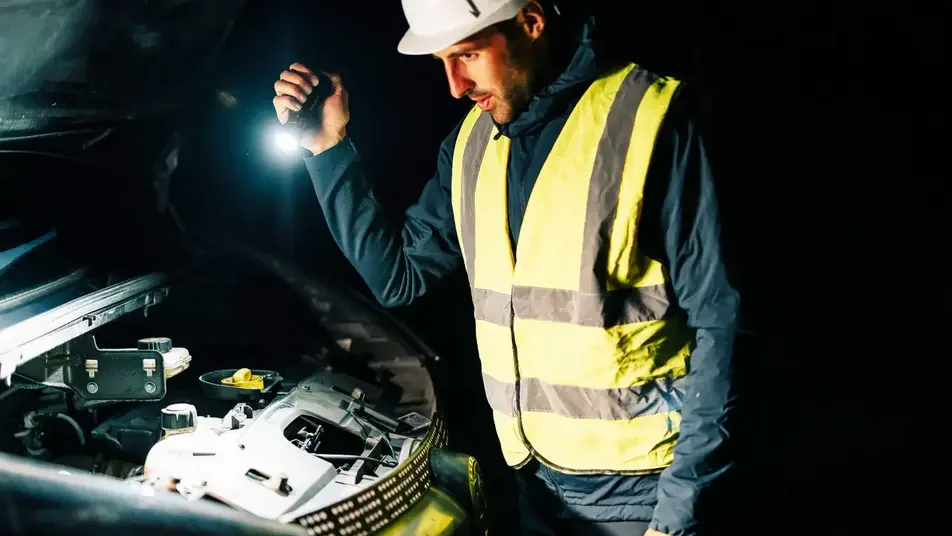
To manage glare effectively, adopt three practical techniques: first, select a right-angle head torch with a 180-degree rotatable mount, angling the beam slightly downwards toward the hands rather than straight ahead. Second, step down brightness to medium (around 120 lumens) or low (30 lumens) for reflective surfaces. Third, detach right-angle lights and use their integrated magnetic tailcaps to anchor the torch to an adjacent steel subframe or strut mount, creating off-axis side lighting that eliminates direct glare back into safety eyewear.

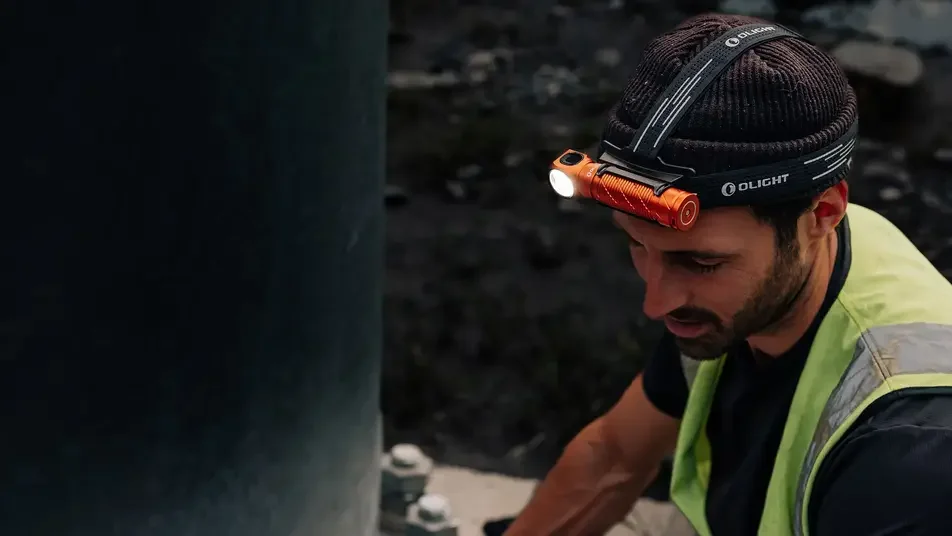
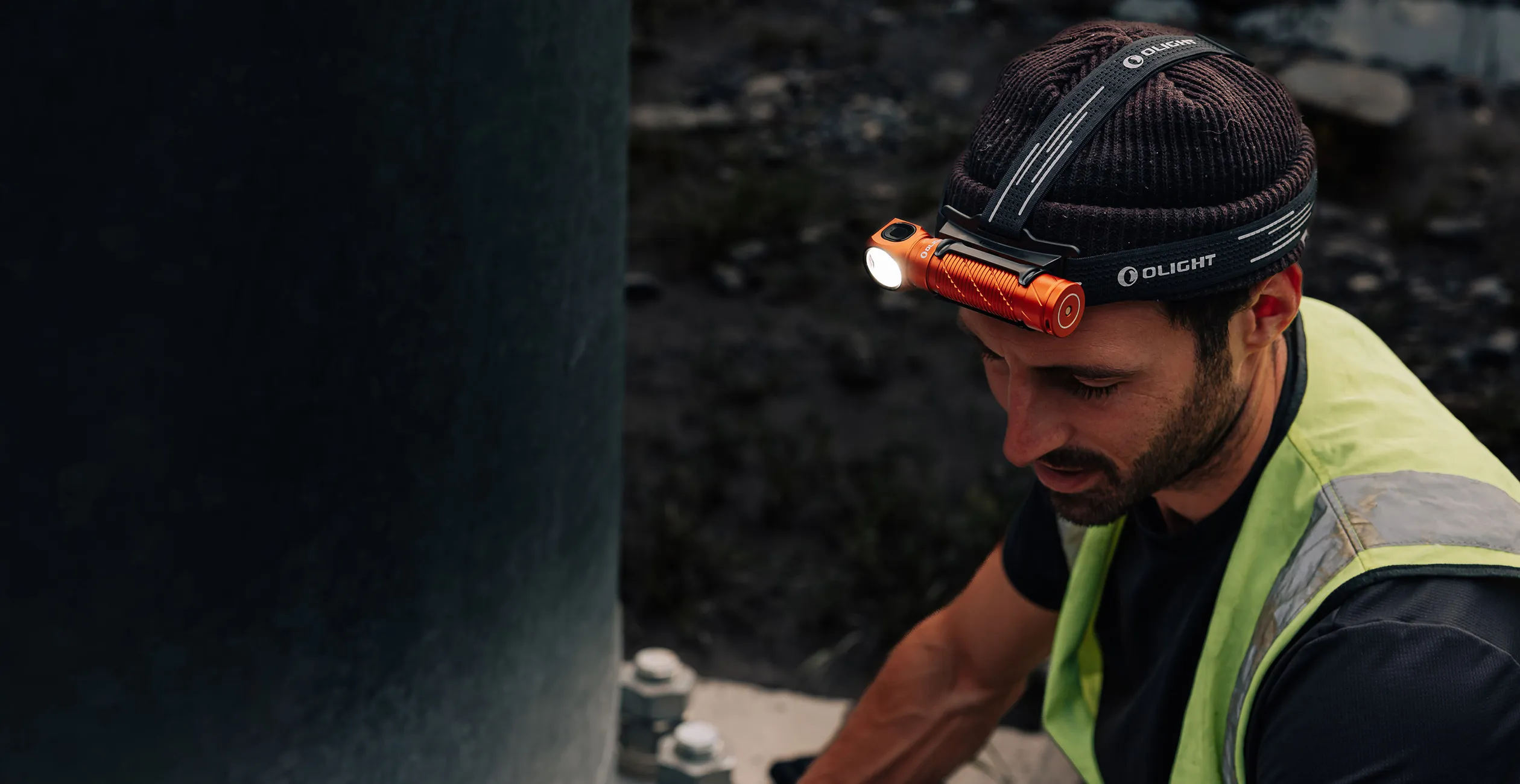
Olight Perun 3 Rechargeable Head Torch
Engineered for heavy mechanical maintenance and workshop tasks. The right-angle design allows instant transition from headband wear to magnetic work light on vehicle panels.
- Max Output & Throw: 3,000 lumens flood beam with 160 m throw
- Shift Runtimes: 120 lm Medium mode runs for 25 hours; 30 lm Low mode runs 89 hours
- Power Source: Customised 5000 mAh 21700 rechargeable Li-ion battery
- Durability: IP68 submersible, 1.5 m impact-resistant aluminium alloy body
- Hands-Free Flexibility: Includes headband, pocket clip, lanyard, and strong magnetic base
Straps, caps and hoods: keeping a head torch in place on a creeper
Rolling beneath a chassis on a mechanic's creeper tests headband stability. Standard elastic headbands easily slip off when pressing the back of your head against a creeper headrest or navigating around exhaust pipes and sway bars.
To ensure a secure fit, choose a headband featuring an optional overhead top strap to prevent downward slippage when working on your back. If wearing a workshop cap or beanie, tighten the circumference band firmly over the brim. Ensure the head torch bracket features a low-profile mounting plate so it does not protrude excessively or catch on brake lines and wiring bundles inside tight transmission tunnels.

Runtime across a full shift: swap cells or top up at lunch?
A common mistake among tradespeople is evaluating a head torch purely on maximum Turbo lumens. In reality, Turbo modes (1,000 to 3,000 lumens) step down within minutes to prevent thermal throttling and protect the LED driver.
For an uninterrupted workshop shift, evaluate the continuous runtime at 100 to 200 lumens. Standard AAA or small integrated 18350 cells deplete in 2 to 3 hours, forcing frequent midday charging. High-capacity 21700-powered platforms (such as the 5000 mAh cell inside the Perun 3) deliver up to 25 continuous hours at 120 lumens, easily covering a full trade week of typical close-up mechanical diagnostics on a single charge.
Cleaning grease and brake cleaner off lenses and straps
Automotive chemicals deteriorate lighting gear quickly. Aggressive solvents such as aerosol brake cleaners (containing tetrachloroethylene, acetone, or heptane) can haze polycarbonate optical lenses and dissolve elastic polymers within seconds.
Follow these essential maintenance protocols to extend tool lifespan:
- Lens Care: Never spray degreaser directly onto the torch face. Clean TIR lenses and glass surfaces using isopropyl alcohol (IPA) or mild citrus dishwashing liquid on a clean microfibre cloth.
- Headband Washing: Detach elastic bands monthly and soak them in warm water with mild laundry detergent to strip embedded grease and sweat without breaking down the rubber weave.
- O-ring Lubrication: Apply a light film of dielectric silicone grease to the tailcap threads twice yearly to maintain the IP68 waterproof and solvent barrier.
Frequently asked questions
What is the best lumen output for mechanics working inside engine bays?
For close-up mechanical work between 20 cm and 60 cm, an output of 30 to 120 lumens is ideal. It prevents harsh glare and reflection off metallic surfaces while maintaining battery life. High modes (600+ lumens) should be reserved for brief inspections of deep chassis rails or finding dropped fasteners.
Why are right-angle head torches preferred over fixed centre-mounted lights?
Right-angle head torches offer unmatched modularity. When unclipped from the headband, tools like the Olight Perun 3 double as magnetic work lights that attach directly to vehicle body panels, suspension arms, or bonnet struts, directing illumination from off-axis angles to eliminate eye glare.
How can I prevent my head torch lens from getting scratched or fogged by workshop grease?
Keep aerosol brake cleaners and harsh solvents away from optical lenses. Wipe down the light face after every shift using a damp microfibre cloth with mild soapy water or isopropyl alcohol, and store the headlamp in an aluminium or EVA case rather than loose in a steel tool chest drawer.