TL;DR: Mineral fluorescence hunting across Australian outback tracks requires pure 365nm ultraviolet radiation paired with an optical black filter lens to eliminate purple spill. To spot faint mineral luminescence, fossickers must operate in pitch-black conditions, maintain sweeps under one metre, and account for thermal regulation during warm Australian summer nights.
Field fossicking and mineral prospecting across Australian terrain change dramatically after sunset. From dry riverbeds in Western Australia to historic mining dumps in Victoria, geological specimens often hide their true signatures by day, only releasing vibrant ultraviolet responses under narrow-band photons. Mastering how to use black light flashlight units requires understanding photon energy, optical filtering, and outdoor observation limits under local climatic conditions.
| Scenario | Model | Peak Throw / Candela / Lumens | Weight (inc. battery) | Charging Format | Key Trade-off |
|---|---|---|---|---|---|
| Multi-source UV & field prospecting | Olight ArkPro | 205 m / Dual / 1,500 lm max (1,200 mW UV) | 115 g | USB-C & Magnetic Dock | Flat unibody profile requires secure pocket seating |
| Ultra-compact hands-free sorting | Olight Oclip Pro S | 80 m / 600 lm max (800 mW UV) | 53 g | USB-C / Magnetic | Compact cell limits runtime on high turbo outputs |
Table of Contents

Why do moonlight and a nearby lantern wash out the glow?
Fluorescence is not a reflection of existing light; it is an absorption and re-emission process. When an ultraviolet photon strikes an activator ion within a mineral lattice, an electron jumps to a higher energy state and promptly releases a lower-energy visible photon as it returns to its ground state. Because this emitted light is relatively faint, even weak white ambient light or bright lunar wash easily overwhelms the visual contrast needed for the human eye to detect the shift.
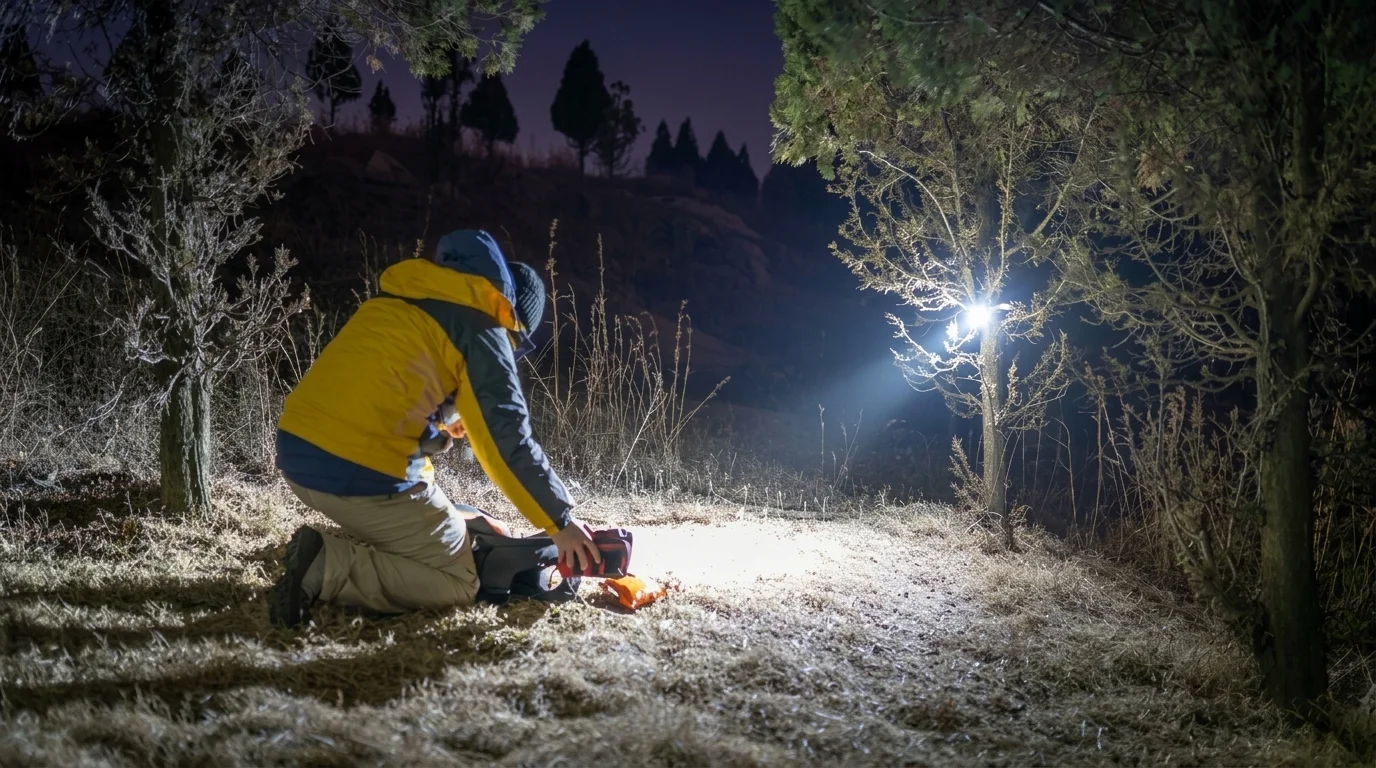
When operating outdoors across remote Australian leases, keeping personal lighting completely dark is essential. A working headlamp or nearby camp lantern floods the search zone with broad-spectrum lumens, making subtle mineral luminescence invisible. For effective UV fluorescence rock hunting, turn off broad white lights and allow your eyes to adapt to scotopic or mesopic conditions before sweeping the terrain, ensuring compliance with local outdoor safety guidelines (Refer to Flashlight Wiki: ANSI FL1 Standard Specifications).
How far away can UV fluorescence be seen?
The effective detection distance obeys the inverse square law of light propagation. As distance doubles between the torch emitter and the mineral surface, the intensity of ultraviolet radiation delivered drops to one-quarter. Because the resulting fluorescent emission also disperses over distance back to your eyes, signal loss happens exponentially.
In real-world conditions across outback sites, while highly reactive specimens such as Australian hyalite opal or scorpion cuticles can trigger visibility from two to three metres away, most common minerals require holding the beam between 30 and 100 centimetres from the ground. Sweeping slowly at this height delivers enough radiant flux density to excite responsive mineral activators without washing out the field.

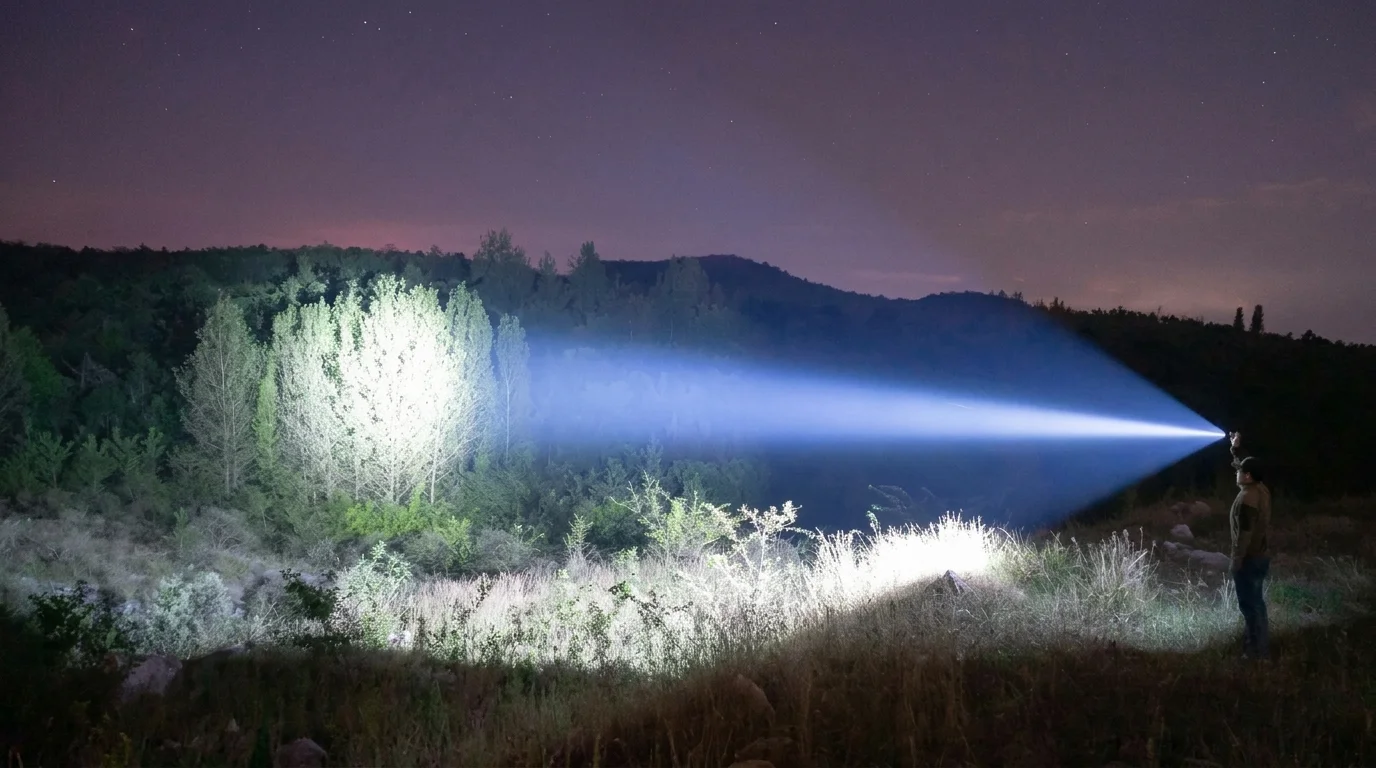
Engineered for outdoor multi-tasking, the ArkPro combines an intense 365nm UV emitter delivering up to 1,200 mW optical output with high-power white flood and spot beams. Its slim unibody design slides easily into trail packs.
- UV Output: High: 1,200~580 mW | Low: 360 mW (365 nm)
- White Light: 1,500 lm Flood & 800 lm Spot (205 m throw)
- Durability: IPX7 waterproof rating with aluminum build
Fluorescence vs reflection vs purple spill: why a black filter lens matters
A standard unfiltered UV diode produces unwanted visible light around 400nm alongside its primary ultraviolet output. This visible bleed bathes rocks in a bright purple haze. When bright purple light hits a pale quartz or feldspar surface, it produces a simple specular reflection that beginners frequently mistake for a fluorescent glow.
A filtered 365nm UV flashlight incorporates a specialized Woods glass optical filter that absorbs visible wavelengths above 400nm while transmitting deep 365nm UV energy. Genuine fluorescence transforms the absorbed ultraviolet wavelength into a completely different visible color—such as electric green, warm orange, or vivid blue—emanating directly from within the rock itself, without any distracting purple sheen.
Where to look outdoors: rocks, fungi, insects and plastics
Understanding what does a uv torch show expands nighttime prospecting well beyond rock hunting. Australian dry creek beds and limestone outcrops host minerals containing trace activators like manganese, uranium, or europium, causing secondary minerals like calcite and willemite to react distinctly under narrow-band excitation.
Beyond geology, natural biological organisms exhibit brilliant responses. Bark-dwelling lichens display orange chlorophyll patterns, bracket fungi glow under damp canopies, and scorpions flare with striking blue-green brightness due to beta-carboline compounds in their cuticles. Synthetic discards like nylon ropes, fishing line, and aged plastics also stand out sharply against dark forest soil.

Weighing just 53 grams, the Oclip Pro S clips securely to caps, pockets, or straps for close-range hands-free mineral sorting and camp inspection. It provides high-purity 365nm UV along with white and RGB output modes.
- UV Emitter: 365–370 nm (Up to 800 mW peak output)
- White Lumens: 600 lm max output (80 m throw)
- Carry Options: Sturdy mounting clip and magnetic base
Eye and skin safety with 365nm torches under Australian summer heat
High-powered UV-A light is invisible to the human eye, which means the normal blink reflex will not protect you from excessive exposure. Never point an active ultraviolet torch directly at anyone's face, and be cautious around reflective ground surfaces like flat water or pale quartz boulders that can bounce invisible beams upward.
Clear polycarbonate safety glasses provide reliable protection by naturally absorbing UV-A radiation, filtering out stray reflections while preserving the true fluorescent response of target minerals. When sweeping close to the ground for hours during warm Australian summer nights, wearing rated safety glasses prevents eye strain and protects against stray backscatter. Furthermore, purchasing from verified local retailers ensures consumer protection compliance (For Australian consumer guarantee terms, see ACCC: Consumer Rights and Guarantees).
Frequently asked questions
Can I use a 395nm torch for rock hunting instead of 365nm?
While a 395nm light can excite some high-reactivity specimens, it emits a heavy purple visible glare that washes out faint mineral signals. A 365nm torch with a dark filter delivers higher excitation energy and a darker background, making subtle minerals much easier to spot.
Why do some rocks glow for a moment even after the UV beam turns off?
This delayed emission is known as phosphorescence. Unlike instant fluorescence, phosphorescent materials trap electrons in excited states before slowly releasing photons over several seconds or minutes after the ultraviolet source is removed.
Do all Australian opals fluoresce under UV light?
No. Common and precious sedimentary opals from inland fields like Coober Pedy or Lightning Ridge show variable, often subtle responses. However, hyalite opal found in volcanic settings fluoresces an intense bright green under UV light due to trace uranium impurities acting as activators.