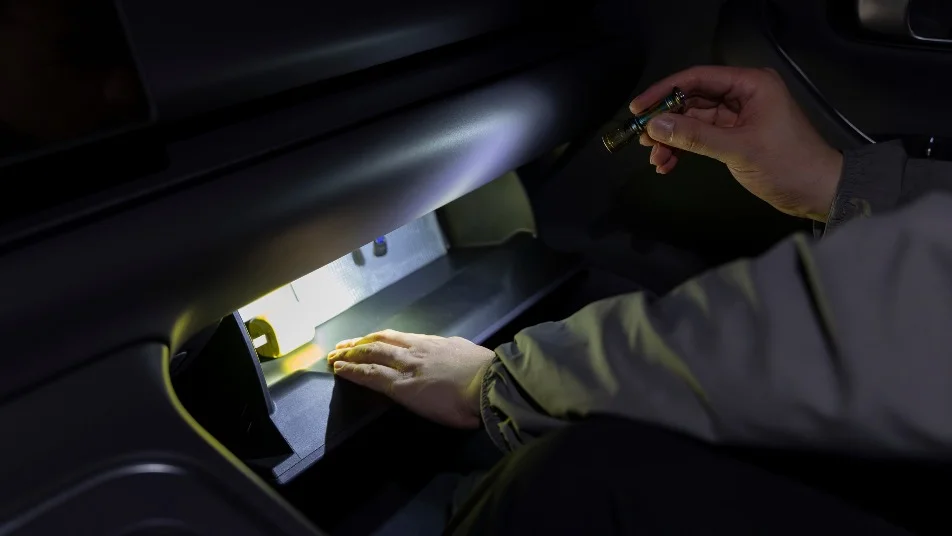
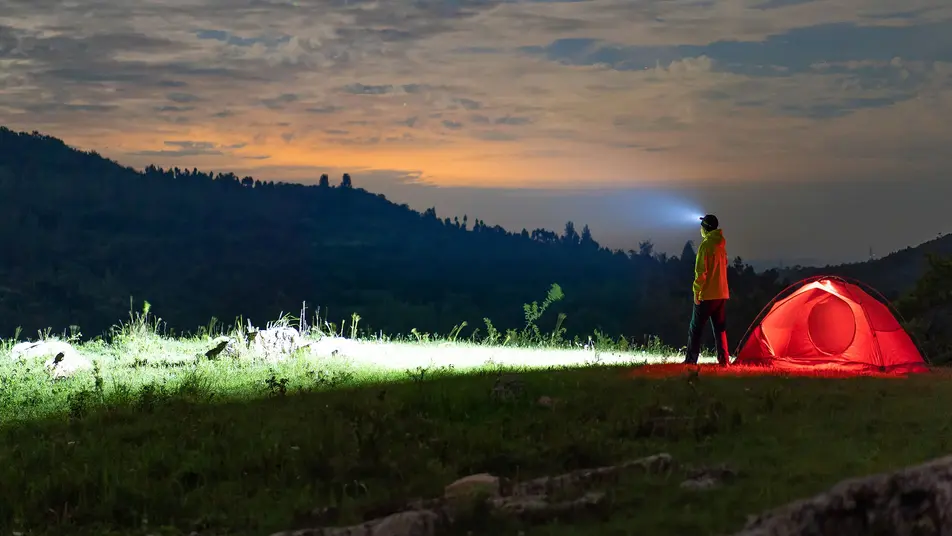
Advertised 1 km beam distances often disappoint runners, farmers, and searchers because ANSI standards measure light down to 0.25 lux—the brightness of full moonlight. For practical nighttime identification in Australia, realistic working range is roughly 30% to 50% of the rated figure. High-candela searchlights like the Javelot Turbo 2, Marauder Mini 2, and Warrior X 4 cut through atmospheric haze to deliver dependable long-range visibility.
In field testing across rural paddocks, the Olight Javelot Turbo 2 proved to be the best overall long-distance spotlight due to its massive 650,000 cd beam intensity and focused 1,500 m beam throw. While high-lumen floodlights illuminate wide areas, focused high-candela spotlights maintain target recognition over 500 metres in real-world atmospheric conditions.
- 1. Quick Answer: Rated Beam Distance vs Real Identification Range
- 2. Candela, ANSI Beam Distance and Identification Range Explained
- 3. Why Does a Very Narrow Beam Feel Harder to Use Up Close?
- 4. Weight, Handle Design and Arm Fatigue During Extended Search
- 5. Runtime at Maximum vs Sustained Thermal Output
- 6. Rain, Dust and Humid Air: What Cuts Real Throw in the Bush?
- 7. Spotlighting and Marine Lighting Rules to Check in Your State
- 8. What are the best long distance flashlights?
- 9. What's the most powerful spotlight?
- 10. What is the best long-range flashlight?
- 11. Frequently Asked Questions (FAQ)
1. Quick Answer: Rated Beam Distance vs Real Identification Range
Understanding specifications is critical when searching for the best spotlight for long distance. Manufacturer claims stating "1,000 metres" or "1,500 metres" refer strictly to the ANSI/NEMA FL1 beam distance standard. At that rated distance, the remaining light measure equals 0.25 lux—roughly equivalent to full moonlight. While 0.25 lux helps you spot a reflective marker, it is insufficient for resolving fine detail. To reliably identify stock, property intruders, or navigation buoys, expect practical working range to be 30% to 50% of the official ANSI specification. Browse our dedicated spotlights hub or explore the specialized Javelot long-range series.

Olight Javelot Turbo 2
Delivers up to 2,000 lumens and 650,000 cd beam intensity. Built with an integrated high-capacity battery pack, side switch indicators, and a tactical dual-stage tail switch for farm management and search operations.
Buy Now2. Candela, ANSI Beam Distance and Identification Range Explained
Understanding the technical distinction between Lumens and Candela is essential when choosing a long-range spotlight. Lumens measure total light output across all directions, whereas Candela measures light intensity concentrated into a single central beam axis. A high-lumen floodlight can struggle to reach 300 metres if the beam spreads broadly, whereas a spotlight with a deep parabolic reflector concentrates light into over 600,000 candela (like the Javelot Turbo 2), throwing light out to 1,500 metres.

Olight Warrior X 4
Outputs 2,600 lumens with 99,200 cd beam intensity. Features both Type-C USB charging and MCC magnetic charging, a heavy-duty strike bezel, and dual-stage tactical tail switch.
Buy Now3. Why Does a Very Narrow Beam Feel Harder to Use Up Close?
Dedicated long-throw spotlights utilize tight beam angles (<5 degrees) to maximize distance. However, using a hyper-focused spotlight for close-range tasks creates a blinding hot spot surrounded by dark peripheral shadows, causing severe eye strain. Hybrid models like the Marauder Mini 2 feature separate optical channels—a dedicated array of flood LEDs alongside a central throw lens—allowing operators to toggle between wide area illumination and long distance pinpoint search with a single switch.

Olight Marauder Mini 2
Combines a massive 10,000-lumen wide floodlight with a focused 630m spotlight beam. Equipped with a 3D rotary knob switch, physical toggle switch, and thermal sensor protection.
Buy Now4. Weight, Handle Design and Arm Fatigue During Extended Search
Holding a heavy spotlight out of a 4WD window or while conducting a perimeter search causes rapid arm fatigue if ergonomics are poorly designed. Compact long-throw flashlights weighing under 250 grams (like the Warrior X 4) can be comfortably operated single-handed for hours. Full-sized searchlights incorporate ergonomic knurling and balanced battery weight to distribute load evenly across the hand during prolonged search duties.
5. Runtime at Maximum vs Sustained Thermal Output
Due to intense heat generation at maximum Turbo output, all high-power spotlights step down drive current after 3 to 10 minutes. When evaluating lights for long night shifts, examine the sustained output level. A torch maintaining a constant 500 to 1,000 lumens for hours without stepping down provides far greater field utility during search operations than a torch that drops from 5,000 lumens down to a dim flicker within minutes.
6. Rain, Dust and Humid Air: What Cuts Real Throw in the Bush?
In Australian outdoor environments, atmospheric moisture, dust particles, and smoke scatter light beams—a physical phenomenon known as Rayleigh and Mie scattering. High-kelvin cold white beams (6500K) create a visible wall of backscatter haze in foggy or dusty conditions. Spotlights engineered with neutral white or warm tint LEDs penetrate airborne moisture more effectively, ensuring clearer target visibility across humid river valleys.
7. Spotlighting and Marine Lighting Rules to Check in Your State
Operating high-power spotlights in Australia requires strict adherence to state wildlife and maritime legislation:
- Land Spotlighting Laws: Carrying spotlights on public lands or in state forests for illegal hunting is prohibited across all Australian states (e.g., NSW Game Licensing regulations and VIC Game Management Authority rules). Spotlighting is restricted strictly to private property pest control with explicit landholder permission.
- Marine Navigation Rules: Under Maritime Safety regulations (such as AMSA COLREGs), handheld searchlights must never be shone directly at the bridge of oncoming vessels or navigation channels, as blinding night-adapted vision creates collision hazards.

What are the best long distance flashlights?
The best long-distance flashlights feature deep smooth reflectors or specialized TIR optics that produce over 90,000 candela. Top models include the Olight Javelot Turbo 2 (1,500m throw), Warrior X 4 (630m throw), and Marauder Mini 2 (630m spot beam), offering concentrated beam throw for farm inspection, search operations, and marine navigation.
What's the most powerful spotlight?
The most powerful handheld searchlights combine extreme lumen volume with high candela beam intensity. Ultra-long distance spotlights like the Olight Javelot Turbo 2 project 2,000 lumens across a massive 1,500-metre range, while the Marauder Mini 2 combines 10,000 lumens floodlight with a focused 630-metre spot beam channel.
What is the best long-range flashlight?
The best long-range flashlight for practical field use is the Olight Javelot Turbo 2. Its 650,000 cd beam intensity projects a tight beam out to 1,500 ANSI metres, providing clear visual target identification up to 500 metres in rural Australian conditions.
11. Frequently Asked Questions (FAQ)
Last Updated: October 2026. Published with field paddock illuminance measurements, ANSI vs real target identification ratios, and state spotlighting compliance guidelines.
Which long-distance spotlight setup do you rely on for farm boundary patrols or boat navigation?